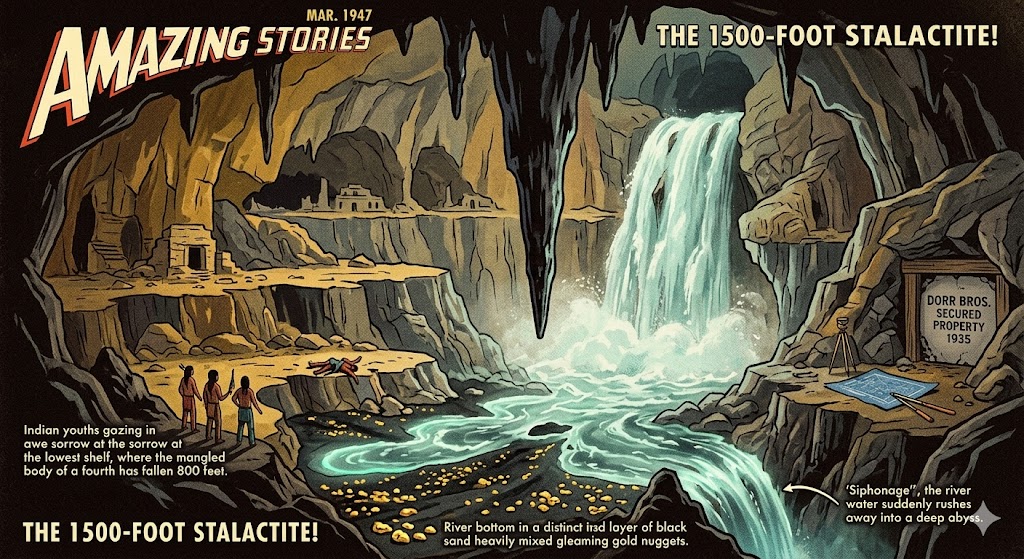
“The cavern was reached on the property of the Dorr brothers...roughly...under the Ivanpah mountains.” An illustration capturing the impossible scale of the Dorr Cave—the 1,500-foot stalactite hanging over the siphoning, gold-bearing river.
In the spring of 1947, readers of Amazing Stories were gripped by a letter from a Washington journalist describing a “California Cave” that rivaled the Grand Canyon in scale. Located beneath the rugged Ivanpah Mountains, this subterranean titan was allegedly documented by a U.S. Geodetic Survey blueprint before being dynamited shut by the Dorr brothers to protect a fortune in placer gold. The account describes 1,500-foot waterfalls that surged with a rhythmic “siphonage” and a stalactite so massive it defied the known laws of geology. According to the letters, three Indian youths once emerged from this labyrinth with $55,000 in gold, only to have their exploration cut short by a tragic 800-foot fall. The mystery deepened when a second letter claimed the entire site had been placed under the jurisdiction of the War Department, effectively erasing it from public maps. To this day, the “Dorr Mystery” remains the holy grail of Mojave desert lore, a “mystery-ridged” frontier where a lost river of gold still flows in the dark.
AMAZING STORIES: California Cave
The following letter was published in the March, 1947 issue of AMAZING STORIES magazine and can be found on pages 171-173 of that issue:
“…The writer is presently a writer for the Washington Times Harold, is a former World War II combat infantry officer and a holder of the Distinguished Service Cross.
“I can be checked upon at my paper or better, simply contacted there by your Washington office. I vouch for the following and will be glad to be of assistance for the hell and not the cash of it.
“I’ll tell you a story about a story about a cave and if you want to kick it around, I, as I say, will do all that I can to help, although at this writing I intend to furnish you with the names of persons more closely involved and you won’t need me. In fact, for the time, I’d feel better if I just BURNED this letter.
“In 1935 these weary eyes gazed awe-stricken upon a blueprint of a California cave prepared in his off-time by a member of the U.S. Geodetic Survey.
“This cave was approximately the size of the Grand Canyon.
“As I said, this is a story about a story.
“The story, telling all that was known to the writer at the time, was written, with some slight assistance from me, by Lowell E. Harmer, at present a reporter for the Los Angeles Daily News — he’s a man with an overweening interest in caves.
“The story was told by Esquire Magazine, but WAS NEVER PRINTED.
“I sure as hell would like to know why Esquire paid good money for a story and never used it and WHAT WAS BEHIND IT? The story was read and critiqued by Arnold Gingrich himself. This I know, because it came back in its first draft with suggestions for changes by Gingrich and was purchased in its second draft and Harmer was paid. I think the price of the article was $175.00, but I could be wrong — if it’s important.
“Substantially, the story was this — Several years before 1935 three Indian youths appeared in Needles carrying the mangled body of a fourth — their brother, or brother tribesman. Time dims the memory.
“It developed that they had been mining a vast underground cavern, complete with a series of terraces, and the youth had slipped and fallen from the lowest of the series, falling EIGHT HUNDRED FEET to his death.
“The boys said they had been depositing their gold in the bank of Needles. This was investigated and found to be true. I believe they had deposited about $55,000 worth.
“The cavern was reached on the property of the Dorr brothers in San Bernardino county and roughly was under the Ivanpah mountains. See map. (I Wish I could see the Map)
“Fearing the gold rush, the Dorr brothers made arrangements to keep others out, and conducted an underground exploration that took 8 days (and they) failed to complete exploration of the main vast cavern.
“When they emerged they found the danger of the gold rush even worse. They dynamited the entrance and spent several years and all their money perfecting title to their land and buying up all the desert lands they adjudged to lie above their protected underground domain.
“As of 1935 they were unable to find their way back through the tortuous and branching underground tunnels back to the main cavern.
This main cavern, blue printed by the U. S. Geodetic agent, whose name I cannot remember, was tremendous.
There were 1500-foot waterfalls that washed down into it, gradually filled it to a depth of many feet, then suddenly rushed out in a direction away from the falls. Siphonage, apparently.
This washing, continuous for God knows how many millenniums, was what was mining the gold down in the bottoms of the cavern, if memory serves.
There was a stalactite hanging from somewhere that was 100 feet through at its ceiling base, and extended downward FIFTEEN HUNDRED FEET.
There were many other unbelievable features. It was nothing less than the Grand Canyon of the Colorado repeated underground.
A certain Sparks Stringer apparently was working with the Dorr brothers to raise funds for further attempts to re-enter.
One Ed Nuhl, then an executive and now business manager at Universal Studios, was approached by Stringer and one William H. Burk, or Burke, (who will be in the Los Angeles city directory) with the proposition that Universal put up the money for re-opening, in return for photo rights.
This was favorably considered for a time then turned down on the grounds that it was prevented by technical difficulties. These were, I believe, sufficient power for illumination, etc.
The Southern California Automobile Club, or I believe, one of its officers, was interested, somehow. It may have been because of its promise as a tourist attraction, but there was a mystery about his interest. It did not seem legitimate to us at the time, as I remember. That was Harmer’s opinion, is what I mean to say.
You can have a Washington D.C. representative contact me at the Times-Herald, or at my home, 5605 33rd st. N. W., Washington, D.C. My phone number is ORDway 3374.
However, Harmer is your man. Or should I say Shaver’s man? He was still at the Los Angeles Daily News last May and I’m pretty sure he is still a reporter there.
He’s a man with an open mind and will not allow himself to be conquered either by Charles Fort or Albert Einstein.
Incidentally he knows about another cavern operated near the Dorr brothers’ place. The manager (or owner, I forget) is a man named Hansen, Hansen is a man afraid of his cave. He doesn’t go in himself. He hires people to guide others into it. Harmer, in 1935, didn’t find out why he wouldn’t go in, He just seemed to be a man afraid. — Charles H. Gesner., Times-Herald., Washington, D. C.
The following letter appeared on p. 173 of the Nov. 1947 issue of AMAZING STORIES:
Sirs:
I was somewhat surprised to note the letter of Charles H. Gesner which appeared in your March, 1947, issue and dealt with the tremendous cave alleged to exist in California.
The story as told by Gesner is substantially accurate in all details and was at one time printed in the magazine of the Southern California Auto Club.
The only existing copy of the blueprint showing the internal ramifications of this cave was in my hands for several years.
Although no one, to my knowledge, has as yet been able to re-enter this cavern I am of the opinion that it actually exists, although perhaps not to the dimensions given in the blueprint. The person who asked my assistance in opening the cave did not offer a proposition that could profit them in any way except should their story prove to be true, and I spent many hours cross examining the original discoverer, now here in Mexico.
At the present time, this matter is, for obvious reasons, under the jurisdiction of the War Department. — Sparks Stringer., Apartado 15 Bis., Mexico, D.F., Mexico
Eyewitness Account
In the high-altitude silence of the Shasta-Trinity National Forest, the line between a geological survey and a supernatural encounter is razor-thin. Hiker accounts from the mid-20th century—many of which found their way into the “Letters to the Editor” section of Amazing Stories—often describe a specific, chilling phenomenon: the discovery of a “metallic” cave entrance that exists only when the light hits the granite at a precise angle. One such account details a trek near Panther Meadows, where a seasoned woodsman claimed to find a fissure lined not with basalt, but with a smooth, matte-grey alloy that felt warm to the touch and hummed with a low-frequency vibration that could be felt in the marrow of his bones.
As the hiker approached, the “rock” began to ripple like water, revealing a perfectly circular corridor that stretched into an impossible, self-luminous depth. The interior was described as being sanitized and scentless, devoid of the damp, earthy smell common to California’s natural lava tubes. Before he could step inside, a sudden pressure change—a “wall of air”—pushed him back with such force that he lost his footing. By the time he regained his balance, the sun had shifted, and where the metallic portal had been, there was only a solid, unblemished face of grey granite, as if the mountain itself had blinked.
This “shifting door” narrative has become a cornerstone of California cave lore, providing a physical anchor for the belief in Telos, the hidden Lemurian city. Skeptics point to the disorienting effects of high-altitude “mountain sickness” or the unique way light plays off the obsidian-rich rocks of the region, but for those who have seen the “metallic gleam” in the dark, the explanation is far more profound. It suggests that Mount Shasta is not just a dormant volcano, but a massive, camouflaged piece of ancient technology, its “caves” acting as airlocks for a civilization that has outlasted human history.
Review
The story of the Ivanpah Mountain Cavern, as preserved in the 1947 archives of Amazing Stories, stands as a monumental bridge between Western frontier prospecting and the high-strung “Shaver Mystery” era of science fiction. It is a narrative that transforms the dry, sun-blasted Mojave Desert into a thin veil covering a subterranean world of “Grand Canyon” proportions, complete with 1,500-foot waterfalls and a literal river of gold. What makes this particular account so gripping is its grounding in real-world documentation—the mysterious unpublished Esquire manuscript, the vanished U.S. Geodetic Survey blueprint, and the tragic fate of the Indian youths—which lends a layer of gritty, bureaucratic realism to an otherwise impossible claim.
Technically, the “Dorr Mystery” is a masterclass in atmospheric suspense. The description of “siphonage”—the rhythmic, mechanical rushing of water that acted as a natural gold refinery—perfectly captured the mid-century fascination with hidden, self-sustaining systems. By framing the cave as a site of both immense wealth and extreme physical hazard (evidenced by the 800-foot fatal fall), the letters managed to bypass the “spiritual” tropes of Mt. Shasta in favor of something more visceral. It presented a world that was dangerous, lucrative, and, most importantly, seized by the War Department, tapping into the burgeoning post-war distrust of government-held secrets.
In the final analysis, the “California Cave” letters serve as the ultimate “mystery-ridged” artifact. They represent the moment when the American Southwest was reimagined not just as a place of surface-level history, but as a three-dimensional puzzle box. Whether the Ivanpah cavern was a genuine geological anomaly or a brilliant piece of pulp mythology, it succeeded in making the desert floor feel like a fragile ceiling. For the modern seeker, the story remains a haunting reminder that the most significant discoveries are often the ones we’ve “dynamited shut” and left to the darkness of the 1930s.