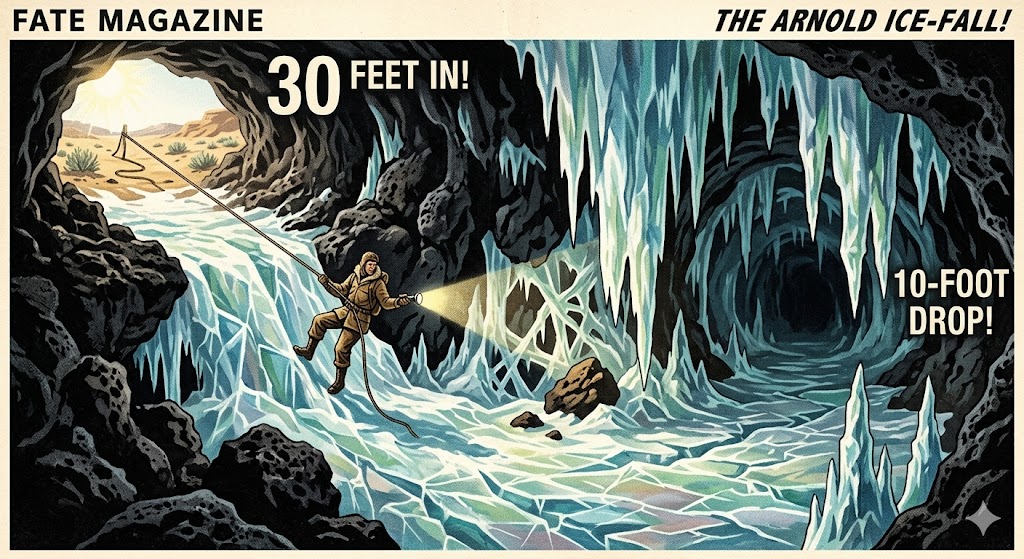
“Although the slope of the ice flow is gradual for the first 30 feet, there is a sharp 'ice-fall'... with a drop of 10 feet.” FATE magazine, June 1952.
Deep within the arid lava lands southeast of Bend, Oregon, lies a geological contradiction that has baffled explorers for decades. As reported by Lester F. Nieman in the June 1952 issue of FATE, the Arnold Ice Cave defies the scorching desert sun with a “veritable river of solid ice” that begins at its very mouth. While the surface world swelters, the cave maintains a lethal, bone-chilling cold that creates a self-regenerating flow of ice. Most mysterious is the claim that chunks of ice carved out by locals would completely regrow within weeks, despite no visible water source. This isn’t ancient glacial ice, but a living, growing subterranean force embedded in an ancient lava flow. To step inside is to leave the high desert and enter a silent, frozen abyss that remains, to this day, largely unexplored and entirely unexplained.
FATE magazine, in its June, 1952 issue, carried the following story by Lester F. Nieman on pages 84-85 titled
“Strange Desert Ice Cave: Arnold Ice Cave”
“The state of Oregon is noted for its scenic beauty. The well-stocked lakes and beautiful parks make it a vacationers’ paradise. One of the strangest spots in the state is the Arnold Ice Cave.
“This natural oddity, only 27 miles southeast of the thriving city of Bend, receives little publicity and many long-time residents of the state have never heard of it.
“To reach the Arnold Ice Cave, take state Route 97 south out of Bend. After traveling 10 miles you will see a marker, “Arnold Ice Cave — 17 miles,” directing you up a graveled road to the east. Not a good road by the state average… it is, nevertheless, passable.
“Your first view of the cave will perhaps disappoint you. It seems merely a pit in the desert, some 50 yards across, with nothing in sight for miles around except sand, sage-brush and a few stunted juniper trees.
“The mouth of the cave is only 20 (feet) below the rim of the pit and you will not encounter much difficulty in reaching the cave entrance.
“At the mouth of the cave is a sign: “Ice underfoot, proceed no further.” As you do proceed further you can see nothing for a few minutes. It is dark after the glare of the desert sun but you notice immediately that it is remarkably cooler.
“With the help of a flashlight you can make out a veritable river of solid ice. And with care you can proceed 30 feet or so into the cave proper. But extreme caution must be taken, for the slick ice underfoot makes treacherous going and there are only a few upthrust rocks to cling to. Before entering the cave it is advisable to secure a rope at the cave entrance as a safety measure.
Under no circumstances enter the cave if you are alone. Although the slope of the ice flow is gradual for the first 30 feet, there is a sharp “ice-fall” beyond this point with a drop of 10 feet. A mishap could mean broken bones and death from exposure, for the temperature is now intensely cold.
“This is not an accumulation of ice formed in winter, nor glacial ice of a by-gone era, but ice that forms of itself all the year around. Chip off a large chunk and take it away with you. Return in a few weeks and you cannot see where you carved it out. Yet there is no water, as such, in evidence.
“The city of Bend obtained its ice from this cave in the days before electric refrigerators were invented. It seems impossible that the broiling desert sun does not melt the ice for a few yards within the cave, but the ice lies at the entrance, and proceeds no telling how far back. No one has dared explore the depths of the cave, and this mysterious phenomenon is entirely unexplained.
“The Arnold Ice Cave lies in the area of an ancient lava flow and is in the Lava River Caves state Park.”
Review: The Thermodynamics of the Impossible
The 1952 account of Arnold Ice Cave serves as a grounded, “Naturalist” entry in the mystery-ridged genre. Unlike the Amazing Stories accounts that lean into ancient civilizations, Nieman’s report focuses on the physical impossibility of the site. The core of the mystery is the “self-forming” nature of the ice. In a region dominated by volcanic heat and porous lava rock, the existence of a perennial ice river that refuses to melt—even at the mouth—suggests a unique subterranean airflow or a localized environmental anomaly.
Nieman’s warning about the 10-foot “ice-fall” adds a layer of frontier danger, framing the cave not just as a curiosity, but as a predator of the unprepared. The fact that the city of Bend once relied on this cave for survival (ice harvesting) anchors the legend in historical reality, making the “mysterious phenomenon” of its regeneration all the more haunting. It is a reminder that some of the most profound “alien” environments on Earth are found not in another dimension, but in the freezing shadows of our own backyard.