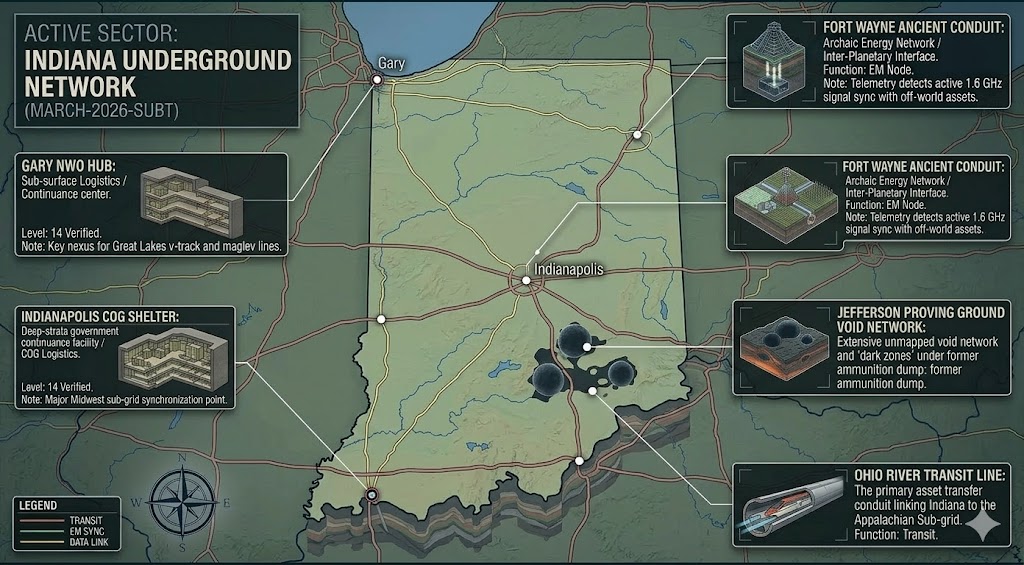
Active Sector: Indiana Underground (MARCH-2026-SUBT) - Intelligence Logged / SLA Optimized.
Indiana Underground
“The ‘Kokomo Hum’ isn’t just a mystery anymore—it’s the audible signature of the Indiana Underground being rebuilt from the inside out.”
While the surface of the Hoosier State is known for rolling plains and limestone quarries, the 2026 declassifications reveal a massive, bi-level grid operating in the deep strata. From the satellite interception hubs in Fort Wayne to the advanced genetic hybridization labs in Terre Haute, the Indiana Underground has become the central processor for the entire Midwestern subterranean network. Whether you are tracking the prehistoric secrets of the Wyandotte “Pillar of the Constitution” or the modern 1.6 GHz frequency syncs at NSA Crane, one thing is clear: the grid is active, and it is much deeper than the history books suggest.
Location: Kokomo Indiana
Functions: Genetics / Bio-Acoustic Testing.
Composed of: Unknown
Levels: Unknown (Significant sub-surface excavation).
Tunnels to: Unknown
Notes: Residents report a persistent “hum” causing physical illness. Intelligence suggests massive tunneling into naturally occurring caverns for containment and storage.
Source: Regional Anomalous Acoustic Logs.
Location: Wyandotte Cave (Crawford County)
Functions: Prehistoric Resource Extraction / Historical Saltpetre Works.
Composed of: Unknown
Levels: Extensive (23+ miles of known avenues).
Tunnels to: Labyrinthine passages; terminates in the Senate Chamber.
Notes: Home to the “Pillar of the Constitution,” a 30ft tall stalagmite column. Evidence of prehistoric quarrying and aboriginal workshops found in the “Pillared Palace.”
Source: 1911 Encyclopædia Britannica / Historical Survey; An old news article about “Wyandotte Cave“, which was said to be very extensive.
[ From the Indianapolis journal , j Wyandotte cave is inferior to Mammoth in length , and yet a walk through its twenty-three miles of avenues and chambers convinces the visitor that there is enough and to spare . Of course he usually takes one of the three routes —twelve miles—and is satisfied . As in the case of all other caves that are in business , a bear bears the credit of discovering this natural wonder . It was in this way : In the early days of the state a hunter one day saw a bear and shot , but did not kill it , whereupon be gave chase and was in close pursuit , when , lo and behold ! it disappeared . This much puzzled the seasoned hunter , and he stood In amazement , but , finally , summoning his resolution , he went to the spot where the animal had vanished . There was a large opening in the side of the bill . Investigation revealed the existence of this vast underground possession . So much for tradition . The same thing occurred with every other cave , and why not with this ? The existence of this cave has been Known for years . As early as 1812 it was owned by a white man who gathered saltnetre in its chambers and made gunpowder—a precious article in the backwoods . The early settlers worked the cave that way for years , going farther and farther from the entrance in search of this mineral . Finally it ceased to be necessary or profitable to make their own powder , and the owner of the cave abandoned it . and the land reverted lo the general government . In 1849 or 1850 a man named Rothrock bought the land and explored the cave . At that time only four miles wore known , but by chance a small opening was noticed and an investigation revealed the fact that a new and greater portion had been discovered . This unknown route was explored , six miles more of cave came into possession of the owner , and it first occurred to him that he had a bonanza . The new find brought the cave into notice , and subsequent discoveries have placed it among the wonders of America .
It was forty-six years ago that Mr . Rothrock , then a young man , commenced acting as guide among the labyrinth of passageways under the hill . Now comes one of the most interesting features of the cave . When he began his visits here he heard the drip , drip of the waters that never cease , and saw the stalactites—little fingers of stone which had been made by the dripping waters . To test the growth of the stone stems , he marked one with the smoke of a candle and awaited results . Almost fifty years have elapsed , and he returns today to the stone timekeeper and measures the growth—three-tenths of an inch . There are columns here seven feet high formed by the constant drop of the water . Duly a few feet from the top you pass from the known to the prehistoric . Wyandotte is beautiful in sediment formation—stalagmites and stalactites that form from floor and ceiling , growing scarcely a hairbreadth in a year , but gradually lessening the distance between their crystal points until in time they meet and form columns of translucent stone , beautiful and chaste
in design , the despair of architects . Fancy a chamber of imposing dimensions , the lofty ceiling supported by these divinely wrought pillars , the concave walls veneered with a coating of sparkling diamonds , t ? 3 delusive glitter of gold and silver in boundless wealth , and you have Aladdin s cave , as rich as the avaricious vision of the Arabian dreamer . The new routes reveal the beauties of crystal ; the old route presents the tumultuous , the grand . The passageways and chambers are rough , broken , and barren ruggedness that turns one s thoughts to grandeur . This route terminates in the climax of attractions . This is the senate chamber , and from its center , seemingly out of the boiling caldron of molten lava that had been chivied and left immovable , rises the Pillar of the Constitution . It stands alone , the grandest column ever erected by man or his Master . Thirty feet in height , seventy-five feet in circumference , with fluted surface and unbroken body , it stands in perpetual darkness , no ray of light ever gilding its sparkling exterior save that from a flickering candle .
Let us take out our note book and calculate the age of this venerable pile . The gray bearded guide has told us that the fragile finger of stone grew three sixteenths of an inch in nearly fifty years—one inch in 245 years . This pillar is thirty feet high , 360 inches ; two whole centuries and forty-five years to one single inch . But then it forms from floor and ceiling , so that two inches are formed in that time . According to our calculation it has been 44 , 100 years since the foundation of this column was laid . But we have omitted one factor . The stone finger would have formed in that time , but this is 600 times as great in diameter . Our pencils and books again—tout this is bewildering . We cannot conceive of the lapse of time contained in the 44 , 000 years . Why go on piling ages upon ages ? Who is bravo enough to say that America lacks age ? Why , compared with this , the Barneses were but squatters upon the homestead of antiquity . Before leaving I found a small piece of rock the Indians had dug from the pillar . It had been 700 years since tbe redskins had made ornaments from this beautiful stone , and I carried it away with me as a reli ( as ancient as an American can well stand up under ) of the column whose foundation was laid in the eternity of the past .
https://idnc.library.illinois.edu/?a=d&d=PFR18960926.2.52
Prairie Farmer, 26 September 1896
WYANDOTTE CAVE, a cave in Jennings township, Crawford county, Indiana, U.S.A., 5 m. N.E. of Leavenworth, on the Ohio river, and 12 m. from Corydon, the early territorial capital. The nearest railway station is Milltown, 9 m. distant. The cave is in a rugged region of high limestone hills, in one of which its main entrance is found, 220 ft. above the level of the Blue river, whose original name, the Wyandotte, was transferred to the cave by Governor David Wallace; it having previously been styled the Mammoth Cave of Indiana, the Epsom Salts Cave, and the Indiana Saltpetre Cave. The exact date of discovery is not known; but early records show it to have been pre-empted by a Dr Adams in 1812 for the manufacture of saltpetre, and his vats and hoppers are still to be seen. After the War of 1812 he relinquished his claim; and in 1819 the ground was bought from the United States government by Henry P. Rothrock, whose heirs are its owners. The earliest account is in Flint’s Geography (1831); the first official report of it was by Dr R. T. Brown (1831); and it was first mapped by the writer (1855), whose map was revised by John Collett, state geologist (1878). No instrumental survey has been made, nor have all its intricate windings been explored. Its known passages aggregate more than 23 m. in length, and 144 places are named as noteworthy. The “Old Cave” contains the saltpetre works, and ends in a remarkable chamber exactly 144 ft. long and 56 ft. wide, in which stands the Pillar of the Constitution, a stalagmitic column perfectly cylindrical and 71 ft. in circumference, entirely composed of crystalline carbonate of lime (satin-spar), fluted and snow-white. A cavity in the column was first claimed by H. C. Hovey as a prehistoric quarry, proved to be such by the stag horns and boulder pounders found in its vicinity. His careful estimate of the rate of stalagmitic growth showed that 1000 years would have been needed to form the lip now covering the incision.
In the N. arm of the newer part of the cave, opened in 1850, is an immense room, styled Rothrock’s Cathedral, 1000 ft. in circumference and 200 ft. high, with a rugged central hill 135 ft. high, surmounted by statuesque stalagmites, near which is another quarry of satin-spar Emery Walker sc.with similar fragments, pounders and aboriginal relics. When Mr Hovey visited this cave in 1855 he found many extinct torches, charcoal embers, poles and pounders, as well as numerous footprints, in the soft nitrous earth of certain avenues, which were left by exploring parties previous to the coming of the white man. In the Pillared Palace a number of large alabaster shafts had been thrown down and fragments carried away. Nearby were so-called “bear-wallows,” which proved to be the remains of an aboriginal workshop, where masses of flint were broken into rectangular blocks; and spalls and flint-chips encumber the floor and choke the passage-way. Milroy’s Temple is a magnificent room, 100 by 150 ft. in its dimensions. It contains many remarkable formations; and its display of helictites, or twisted stalactites, is unsurpassed. As Wyandotte Cave has no large streams and few pools or springs, its fauna and flora are not extensive. Formerly bears, wolves and other wild animals took refuge in its fastnesses; and bats, rats, mice and salamanders are frequent visitors. Blind crawfish (Cambarus pellucidus) inhabit the Crawfish Spring. Cave crickets (Hadenoecus subterraneus) abound. A dozen kinds of insects, with a few varieties of spiders, flies and worms, complete the meagre list. The flora include mainly forms brought in from the outside.
For more full descriptions of Wyandotte Cave and its contents, see Hovey’s Celebrated American Caverns, pp. 123-153; Indiana State Geological Reports, by R. T. Brown, E. T. Cox, John Collett and W. S. Blatchley; and concerning cave fauna reports and papers by C. H. Eigenmann, professor of zoology, Indiana State University. (H. C. H.)
Source:1911 Encyclopædia Britannica/Wyandotte Cave
Location: Fort Wayne, area Churubusco Indiana
Functions: Telecommunication. Satellite check and its programs. Main control on data about ET’s, Authorization Center for programs. Public Relation, programs of how to get known.
Composed of: 16 ETs, 5 Homo Sapiens, 12 Hybrids, 4 Ships.
Levels: Unknown
Tunnels to: Unknown
Notes: Serves as a public relations testing ground for cartoon/media approval. Maintains power to intercept satellite transmissions and trace phone data via centralized computers.
Source: Signal Intelligence (SIGINT) 2026.
Location: Terre Haute, area Rockville – Greencastle Indiana
Functions: Fauna and Plant life Hybridization experiments.
Compose of: ET’s 17, Homo Sapiens Scientists 6,Hybrids 25, Ships 9, Animals 50,000, Seeds from this planet 7,000, different sorts – Seeds from other planets 5,551, Making experiments to mix them.
Levels: Unknown
Tunnels to: Unknown
Notes: Houses 12,551 seed varieties (planetary and off-world). Experiments focus on ecological “improvement” and climate manipulation; petroleum energy is bypassed here.
Source: Biological Asset Manifest.
Location: Naval Support Activity (NSA) Crane
Functions: Microelectronics / Strategic Weapons Storage / Sub-surface Logistics.
Composed of: Hardened silos, deep-strata warehouses, and 8-level “stacked cities.”
Levels: Unknown
Tunnels to: Integrated into the Midwestern Maglev corridor.
Notes: Verified as a primary research node for the US Navy’s most sensitive electronic warfare assets.
Source: NSA Crane Strategic Manifest.
Location: Muscatatuck (Jennings County)
Functions: Cyber-Physical Warfare / Urban Training / Sub-surface Simulation.
Composed of: 200+ brick-and-mortar structures with integrated tunnel networks.
Levels: 4 (Verified sub-surface training zones).
Tunnels to: Unknown
Notes: Utilizes a “JTEN 2.0” node for digital connectivity to global exercises; effectively a “digital-to-physical” portal.
Source: Defense Economic Development Briefing.
Location: Jeffersonville (River Ridge)
Functions: Unmapped Mega-Cavern / Possible Asset Storage.
Composed of: Unknown
Levels: Unknown (Massive vertical scale).
Tunnels to: Unknown
Notes: Warm air streaming from gaps in the earth led to its discovery; currently monitored for stable “oxidation ditch” potential.
Source: SME Global “Billion Dollar Cavern” Survey.
Location:
Functions: Unknown
Composed of: Unknown
Levels: Unknown
Tunnels to: Unknown
Notes:
Source:
🕳️ Intelligence Submission: Indiana Underground
TERMINAL NOTICE: MIDWESTERN BI-LEVEL GRID ACTIVE
The Indiana Underground is a primary node for Bio-Acoustic Research & Satellite Interception. If you have heard the “Kokomo Hum” or recorded anomalous “metallic vibrations” near the Wyandotte Cave system, your report is vital for the 2026 Global Grid.
[SUBMIT YOUR INDIANA UNDERGROUND SIGHTING TO THE SIGHTINGS FORM]
“In Kokomo, the hum isn’t just noise—it’s the sound of the foundation being rebuilt. In Fort Wayne, the cartoons you watch are just the tests for the reality they are coding downstairs.”
About the Author