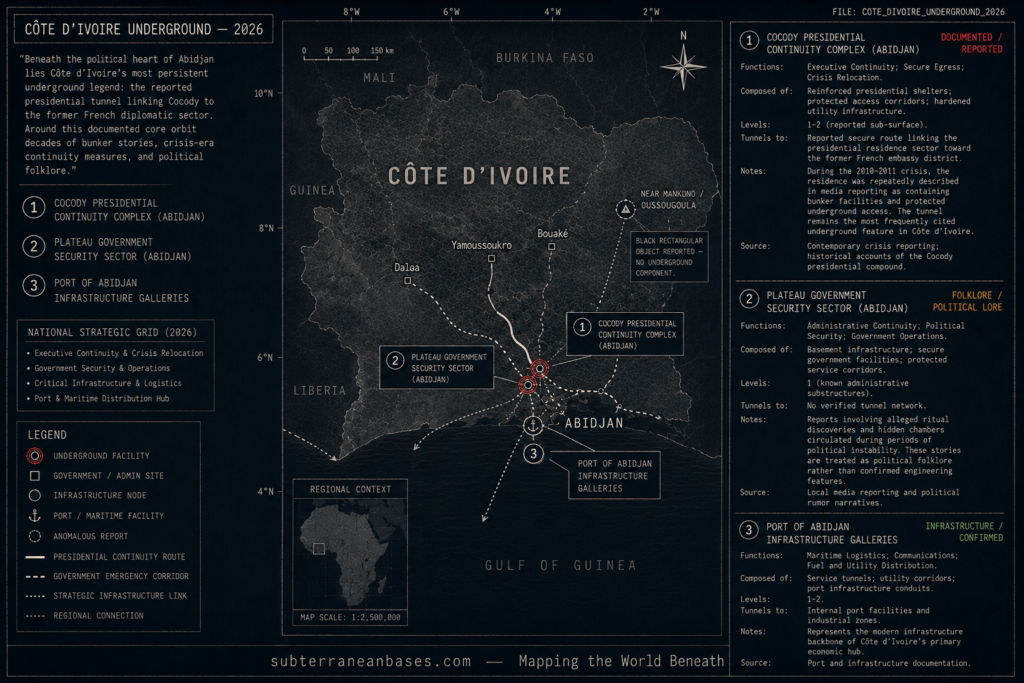
Côte d’Ivoire Underground
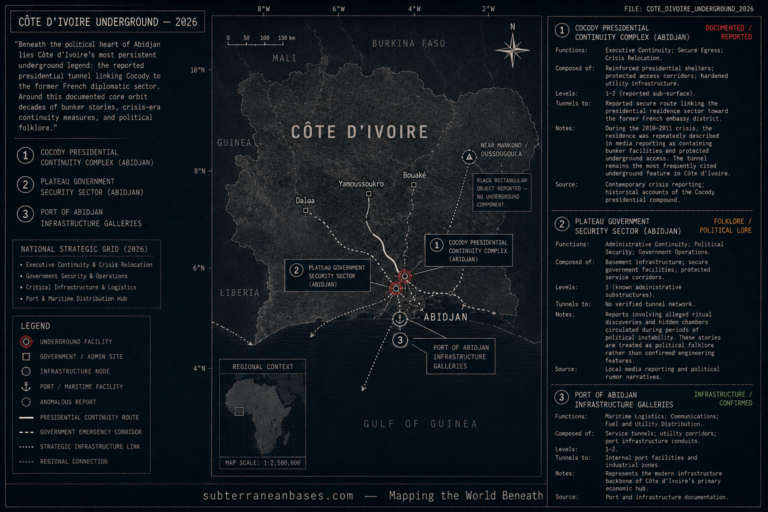
Beneath the political heart of Abidjan, Côte d’Ivoire’s underground story is less about ancient catacombs and more about power, security, and secrecy. The country’s best-known subterranean reference is the presidential tunnel linking the Cocody residence to the former French embassy area, a structure that became part of the national mythos during the crises surrounding Félix Houphouët-Boigny and later Laurent Gbagbo. Around it orbit stories of bunkers, basement shelters, and hidden passageways tied to state security and colonial-era continuity.
Unlike some countries where the underground lore is mostly speculative, Côte d’Ivoire has at least one widely reported and historically documented subterranean feature in Abidjan. The rest sits in the familiar grey zone between political architecture, wartime improvisation, and urban legend.
Location: Cocody, Abidjan
Functions:
Composed of:
Levels:
Tunnels to:
Notes: Multiple reports describe a subterranean tunnel connected to the presidential residence, and the site was widely referred to as a “bunker” during the 2011 crisis. This is one of the strongest location-specific underground claims in the country.
Source:
Location: Abidjan, Plateau / presidency area
Functions:
Composed of:
Levels:
Tunnels to:
Notes: Articles reported alleged mystical or ritual objects discovered near the presidency and prime minister’s office. These accounts are tied to political tension and local belief systems more than verifiable underground engineering.
Source:
Location: Near Mankono / Oussougoula
Functions:
Composed of:
Levels:
Tunnels to:
Notes: report describes a black rectangular object observed in rural Côte d’Ivoire. This is not an underground case, but it is a useful anomalous occurrence entry.
Source:
Location:
Functions:
Composed of:
Levels:
Tunnels to:
Notes:
Source:
About the Author