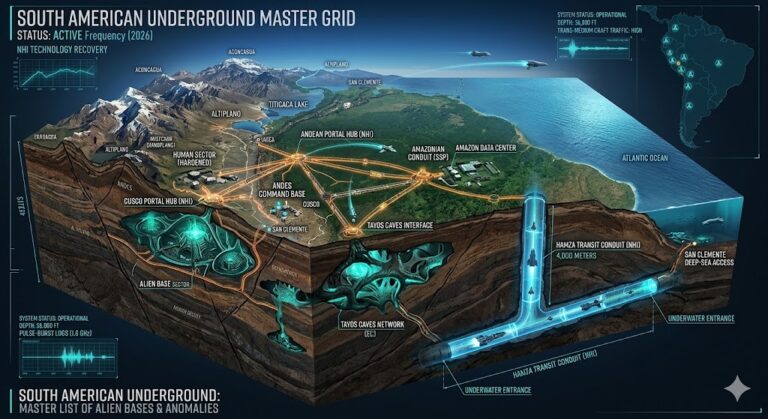
The Cave and Tunnel Entrances (1–10) serves as the “Ground Zero” for subterranean research, mapping the most active portals between our world and the deep-earth civilizations of the Americas. From the glass-walled corridors of Cushman, Arkansas, to the legendary “shimmering portals” of the Superstition Mountains, these first ten entries provide the GPS coordinates for reality-bending anomalies. This section of the Branton Files bridges the gap between ancient indigenous folklore and modern black-ops surveillance, identifying the specific geographic “leak points” where non-human craft and “Joint-Interaction” personnel enter the surface world.
For investigators of the Hollow Earth and DUMBs (Deep Underground Military Bases), this installment is a tactical necessity. It deconstructs the “shroud of secrecy” surrounding sites like Mount Shasta and the Adirondacks, revealing how natural mountain ranges serve as camouflaged hangars for advanced electromagnetic craft. By documenting the physical evidence of thermal-bore tunneling and “blue-light” caverns, Entries 1–10 offer a definitive look at the “sub-global” infrastructure that has operated beneath our feet for centuries, hidden only by our own refusal to look down.
Cave and Tunnel Entrances of the America’s 1 – 10
Compiled by B. Alan Walton
#1 — Page 119 of Harold Osborne’s book “SOUTH AMERICAN MYTHOLOGY”, tells of one of the legends of the Tupari Indians, who live up the Rio Branco (or Parima) river. This river eventually merges with the Rio Negro and is to be found in the upper Mato Grosso region of Brazil. A young Swiss ethnologist, Franz Casper, learned of the following Tuparian tradition when he visited the tribe in 1948:
“…Long ago there were no Tupari or other men. Our ancestors lived under the ground where the sun never shines… Then the men began to stream out in great hordes… Many men remained inside the earth. They are called ‘Kinno‘ and still live there.
“One day, when (most of) the people of the earth have died, the Kinno will come out of the ground here. But the men who Aroteh had let out of the earth did not find room in the same place. We Tupari remained here, the others wondered far away in all directions. They are our neighbors: the Arikapu, Yabuti, Makurap, Arua, and all other tribes.”
Similar legends can be found on pages 265-266 of Daniel G. Brinton’s book, “MYTHS OF THE NEW WORLD”:
“…This cavern, which thus lingered in the memories of nations, frequently expanded to a nether world, imagined to underlie this of ours, and still inhabited by beings of our kind, who have never been lucky enough to discover its exit.
“According to a myth extensively disseminated among the Caribs, Arawaks, Warraus, Carayas, and other South American tribes, in the beginning of things sky and earth were as one, and man abode within the earth in a joyous realm, where death and disease were unknown, and even the trees never rotted but lived on forever.
“One day the ruler of that happy realm walking forth discovered the surface of the world as we know it, but returning warned his people that though sunlight was there, so also were decay and death. Some, however, went thither, and the present unhappy race of men are their descendants, while others dwell in gladness far below…”
#2 — Pages 90-91 of Harold T. Wilkins’ book, “SECRET CITIES OF OLD SOUTH AMERICA”, carries a story of a strange underground city beneath northern Brazil:
“The dead cities of gold and mystery lie, as one has said, round the littoral of the old Maranon-Amazon basin, and on the uplands of proto-South America. Many of the expeditions to one region of the unknown, both European and American… and including that of the lost explorer Irwin have been to the little known territory, watered by the branch of the Amazon tributaries, lying between Obidos and Santarem on the west, and Almereiran on the east, at the embouchure of this mighty waterway. Out of this terra incognita will one day come some startling discoveries. In these, an airship or multi-engined airplane will play a valiant part, as the Latin-Americans would say.
“Somewhere in the north of this region, running from the slopes of mostly unknown and unexplored sierras of the Tumac-Humac and the Parairaima, is a great prehistoric highway known as the Inca Way. It apparently linked this territory of gold, gems and ancient mysteries with what was later the Inca Empire of Quito and Cuzco.
“Dense bush and far-spreading forests and jungles, beset with fierce Indians who use blow-pipes and poisoned arrows, cover up much of this ancient imperial highway, whose makers may be coeval with the old Atlantean empire of South America (many of these ancient highways were built long before the Inca civilization came into existence).
“Deep within this region, at a point where a number of affluents merge, and on the fringes of that mysterious land of Oyapock where lived the Conoris, or white Amazons of Sir Walter Raleigh’s day, is one of a number of dead cities of megalithic date (Compare this following story with the account of another dead city in Chapter 1.).
“The jungle Indians, who shun the place as taboo and sacred, say that gold ingots lie in the dust of the dead city. They say it has pillars in naves of ancient temples and great buildings, grey and weathered with extreme age, that blaze with gold and sacerdotal jewels.
“Around the pillars and the friezes may be seen many hieroglyphic and bizarre letters of no known race. One of these dead cities, far within the forest, and near the slopes of the sierras, is approached by a great stairway of many steps going down, between walls of a towering cliff, to an immense cavern or subterranean.
“The stairway is cut into the solid rock and is slippery with fungi and dripping with dank moisture.
“As one nears the bottom of the stairway, which at this point is inscribed with strange glyphs, one hears the roaring of tumultuous waters. A rushing river goes underground through the middle of the subterranean into a tunnel of more than a mile in length. The roof comes down, and over the lip of a great crack in the rocks, the waters rush into a catadupa — waterfall — at the bottom of which is a maelstrom. None knows what lies beyond.
“Clearly, the spot is very dangerous. It is probable that, beyond this tunnel, lies the dead city… which is said to be about three miles long. The story sounds like a South American version of one of the late Sir Rider Haggard’s novels. Attempts have been made by daring explorers to find the way into the dead city, where, as said, is much gold and many rich jewels, but all have been baffled.
“Within the subterranean approach, there is a hole in the cavern floor at the bottom of which is a quadrate-shaped chamber, clearly of man’s make, in which round the walls are numbers of oblong niches. These niches are for four-fifths of their height walled up with stones neatly laid on each other and cut by skilled masons.”
Chapter 1 of the same book, pp. 23-24 carries a similar story:
“…Here is an account of one in a remote region of Brazilian Guiana, which I take from a travel diary of my own:
“‘I hear of a place where three streams unite and spread out in the waters of a large and deep Lago (lake). I am told that some of the “rare plucked uns” among the New York Four Hundred, young men, and pretty girls, have visited this place. One knows when one is in the neighborhood, for one hears, coming through the aisles of the deep forests, a roar of thunderous reverberations. It is one of the catadupas which frequently figure in the accounts of the travels of the hardy, valiant banderitas into the Geraes and the Goyaz and the Matto Grosso, in the eighteenth century.
“‘…Waters vanish over a lip of rock into a great cavity. Here, a great hole yawns in the earth. Close by, many lichened and grey stone steps of a very ancient stairway, ‘half as old as Time’, like the red rose city of Petraea, are cut in the rock of black basalt.
“‘Reaching the bottom of this stairway, one is startled to find unknown glyphs, or, as they seem to be, ancient and unknown letters cut in the rock, which is dank with the spray of the falling waters. One passes into an immense cavern where the air is fresh and cool. Looking up, one sees that the roof is pierced with ancient ventilation shafts, as it might be of a Great Western railroad tunnel in the west of England.
Inside the great cavern, under an archway, one hears an underground stream roaring into the darkness, which is Stygian. No forest Indians will visit the place. But if one can obtain a canoe, one can paddle in the deep darkness to a point where the walls close in, and the roof comes down as in Edgar Allan Poe’s Pit and the Pendulum, in the dungeons of the old Dominican Inquisition in Toledo. Dangerous eddies appear and white foaming waters roar over the brink of a whirlpool.
“‘…One of the war-time frogmen might try his luck beyond, but he had better be accompanied!
“‘…Off the main cave, a labyrinth of passages branches out. It is anyone’s guess what lies beyond the maze. But one passage leads into an eerie mausoleum. Here, in wall-niches around, human skeletons are walled up. Above each partition, however, peers a grinning skull!
“‘Who are these guardians of this mysterious buaca? Why were they walled up, and when? On a frieze, or fresco, over each skeleton, strange hieroglyphs are carved deeply in the rock, or they may be signs of some unknown and ancient syllabary. No one knows if this weird buaca contains hidden treasures, nor what purpose it served. The forest Indians whisper that, if one follows the right path through the maze of passages, one will finally emerge into the grey ruins of a city of the long dead.’”
In his book “THE COMING RACE”, Edward Bulwer Lytton seems to support the idea of dead cities underground which have been abandoned by the ancient inhabitants thousands of years ago as they sought other lands (above or below the surface) where they could re-settle.
The following quote comes from chapter IX of his book:
“…A band of the ill-fated race thus invaded (had) taken refuge in caverns amidst the loftier rocks, and, wandering through these hollows, they lost sight of the upper world forever.
“Indeed, the whole face of the earth had been changed by this great revolution; the land had been turned into the sea, sea into land. In the bowels of the inner earth even now, I was informed as a positive fact, might be discovered the remains of human habitation, — habitation not in huts and caverns, but in vast cities whose ruins attest the civilization of races which flourished before the age of Noah (and perished with the flood), and are not to be classified with those genera to which philosophy ascribes the use of flint and ignorance of iron.”
#3 — Pages 1-6 of Erich Von Daniken’s book, “THE GOLD OF THE GODS”, tells of the remarkable discovery of a vast system of tunnels under Ecuador and Peru, which have only been little explored and which contain ancient treasures of a long-vanished civilization:
“…To me, this is the most incredible, fantastic story of the century. It could easily have come straight from the realms of Science Fiction if I had not seen and photographed the incredible truth in person.
“What I saw was not the product of dreams or imagination, it was real and tangible.
“A gigantic system of tunnels, thousands of miles in length and built by unknown constructors at some unknown date, lies hidden deep below the
South American continent. Hundreds of miles of underground passages have already been explored and measured in Ecuador and Peru. That is only the beginning, yet the world knows nothing about it.
“On July 21, 1969, Juan Moricz, an Argentine subject (resident), deposited a legal title-deed signed by several witnesses with Dr. Gustavo Falconi, a notary in Guayaquil. The deed sets out Moricz’s claim to be the discoverer of the tunnels as far as the Republic of Ecuador and posterity are concerned. I had this document, which was written in Spanish, translated by a UN interpreter. I quote the most important parts of it at the beginning of this incredible story of mine:
“’ Juan Moricz, Argentine citizen by naturalization, born in Hungary, Passport No. 4361689…
“’ I have discovered objects of great cultural and:-historical value to mankind in the Province of Morons-Santiago, within the boundaries of the Republic of Ecuador.
“’ The objects consist mainly of metal plaques inscribed with what is probably a resume of the history of a lost civilization, the very existence of which was unsuspected by mankind hitherto. The objects are distributed among various caves and are of many different kinds. I was able to make my discovery in fortunate circumstances … In my capacity as a scholar, I was carrying out research into the folklore … ethnological and linguistic aspects of Ecuadorian tribes…
“’ The objects I found are of the following kinds:
“’1. Stone and metal objects of different sizes and colors.
“’2. Metal plaques (leaves) engraved with signs and writing.
“‘These form a veritable metal library which might contain a synopsis of the history of humanity, as well as an account of the origin of mankind on earth and information about a vanished civilization.
“’ The fact of my discovery has made me the legal owner of the metal plaques and other objects in accordance with Article 665 of the Civil Code.
“’ However, as I am convinced that the objects, which were not found on my own land, are of incalculable cultural value, I refer to (the next article), according to which the treasure I discovered remains my personal property, but subject to State control.
“’ I beg you, most excellent President of the Republic, to appoint a scientific commission to verify the contents of this document and assess the value of the finds…
“’ I am prepared to show such a commission the exact geographical position and site of the entrance, as well as the objects I have discovered so far…’
“Moricz stumbled on the underground passages in June 1965, during his research work, in which he was ably assisted by Peruvian Indians who acted as skillful intermediaries between him and their tricky fellow tribesmen. Being cautious by nature and skeptical as befitting a scholar, he kept silent for three years.
“Not until he had covered many miles of underground passages and found all kinds of remarkable objects did he ask President Velasco Ibarra for an audience in the spring of 1968. But the President of a country in which nearly all his predecessors had been deposed by rebellions before the expiry of their term in office, had no time for this lone wolf with his incredible tale of discovery. The palace flunkies found the obstinate archaeologist very charming and assured him, after long delays, that the President would be glad to receive him in a few month’s time, but Moricz was finally told he could not have an audience until 1969. Disillusioned and embittered he withdrew to his subterranean retreat.
“The secret entrance to the hidden tunnel system, which is guarded by hostile Indians, is situated within the triangle formed by the three towns of Gualaquiza, San Antonio and Yaupi in the province of Morona-Santiago.”
#4 — The following letter appeared in Feb. 1948 issue of AMAZING STORIES magazine, on pages 164-165.
This letter by Mr. Rhoden appeared right after Mr. (L. Taylor) Hansen’s:
“My dear Mr. Star: In answer to your letter published in the December issue of AMAZING STORIES, I wish to answer the statements you make concerning my facts. You seem to think that I am not telling the truth, even though you graciously admit that I tell ‘lies with ability.’
“First as to Pizarro’s name. I doubt if I misspelled it. However, I have always thought it should be spelled with two z’s as that would hiss so much better. I have never admired the swineherd turned conqueror. Living so much closer to the territory of his misdeeds, do you?
Honestly? However, as the wish is so often the father of to the deed, it is possible I did misspell Pizarro. I do know better.
“Next, and the most important fact. You state:
‘There are no tunnels in Peru and never has the government looked for them. The legend about Atahualpa’s treasures is not as Mr. Gaddis relates it… The treasure, the most important being a golden chair, was hidden in some lake in the mountains and not in secret tunnels’.
“I believe that a part of this statement refers to what I said and not to Mr. Gaddis. I admit of course, that parts of the treasures were hidden in lakes. However, a part may have been hidden in secret tunnels for such tunnels do exist in Peru. For this statement, I quote to you from no less authority than Dr, Wm. M. McGovern.
“Dr. McGovern, the author of ‘Jungle Trails and Inca Ruins,’ has the following qualifications: He is a Ph.D. from the University of London. Also Fellow of the Royal Geographical Society, Assistant Curator of South American Ethnology in the Field Museum of Natural History, University of London, and the respected author of many books.
“Concerning the tunnels in Peru, he has the following to say on page 438 of his entertaining ‘Jungle Trails’ while describing the ancient fortress Saksawaiman (or ‘Sacsayhuaman’ – Branton):
“’ Near the fortress is several strange caverns reaching far into the earth. Here alters to the gods of the deep were carved out of the living rock, and the many bones scattered about to tell of the sacrifices which were offered up. The end of one of these caverns, Chicana, has never been found. It is supposed to communicate by a long underground passage with the Temple of the Sun in the heart of Cuzco. In the cavern is supposed to be hidden a large part of the golden treasure if the Inca Emperors, which was stored away lest it falls into the hands of the Spaniards. But the cavern is so large and so complicated, and so manifold are its passages that its secret has never been uncovered.
“‘One man indeed is said to have found his way underground to the Sun Temple, and when he emerged, to have two gold bars in his hand. But his mind had been affected by days of blind wandering in the subterranean caves, and he died almost immediately afterward.
“’ Since that time many have gone into the cavern never to return again. Only a month or two before my arrival the disappearance of three prominent people in the Inca cave caused the Prefect of the Province of Cuzco, to wall in the mouth of the cavern, so the secrets and treasures of the Incas seem likely to remain undiscovered for the present.’
“By his use of the words ‘said’ and ‘supposed’, McGovern here keeps his facts separated from his theories, as the scientific mind should.
“As Mr. Palmer so ably pointed out, in his answer to your letter, I try to be specific in my articles, and draw a sharp line between fact and theory, no matter how plausible the later maybe. I envy you your residence in this land of Peru, which is apparently the site of man’s first great civilizations.”
— L. Taylor Hansen
(Well, there’s one answer to Mr. Star, and the next letter is another! – Ed.) – [Note: The ‘editor’ of AMAZING STORIES at the time was Raymond A. Palmer, or ‘RAP’ – Branton]
*******
#5 — “Sirs: I have read EVERY issue of AMAZING STORIES, since the middle of 1945. I have enjoyed the magazine very much, however, I think you publish too much bunk which you try to pass off as absolute truth.
“In your December 1947, issue you had a letter from a Mr. Marcial P. Star, of Lima, Peru. It seems that Senor Star is calling several of your authors ‘liars.’ I thought I might be able to shed some light on the controversy.
“Please understand: I am not interested in anyone’s opinions, I am only interested in facts.
“I do not care to attest to the veracity of the statements of Messrs. Gaddis, Kaye, Hansen, etc. Nor do I wish to be interpreted that I am trying to make a ‘liar’ out of Senor Star.
However, I believe that I may be able to offer information that you do not seem to have available.
“I forgot just which tunnels Mr. Gaddis was referring to, however, in all fairness to Mr. Gaddis, and to keep Senor Star’s statement from being taken in the wrong light, I feel compelled to make the statement that THERE ARE CAVES IN PERU -– IN FACT, THERE IS EXCELLENT REASON TO BELIEVE THAT THERE ARE ALSO TUNNELS IN PERU!
“Senor Star makes the affirmation that the Peruvian government has ‘never’ looked for said tunnels. I do not know whether they have or not. I do know, though, that the government does know they are in existence. I, too, have heard of the ‘falling stones.’
However, these sounds were heard in the vicinity of Cuzco! These caves — or, ‘tunnels’ — are known to be in existence, the entrance of one is located on a hill about a quarter of a mile from Cuzco.
“A number of years ago the government sealed up the entrance to this cave after several persons had become lost after entering it. There are said to be several exits, of which at least one is supposed to be under the ‘church’ in Cuzco. It is said that the Incas used (these) tunnels to hide gold in while the Spaniards were searching for said gold… At least one expedition has entered this tunnel in search of the fabled gold. I believe that they had no luck what so ever.
“In proof of my assertions, I offer the following: ‘Treasure and Treasure Hunting,’ and other books by Harold T. Wilkins; ‘Caves and Treasures in Latin America’ (I’ve forgotten the author’s name).
“At the time that I first heard of these caves I wrote to the Peruvian embassy in Washington, and to the American Geological Society, both of these sources informed me that such caves DO exist.
“I have a list of books on the subject, none of which I have bothered to read. However, if there is still any doubt as to the existence of these caves I’ll be glad to write an article for AMAZING STORIES covering this subject.
“I’ll quote ONLY irrefutable evidence.
As I said before, I am not interested in opinions -– I WANT FACTS!
I BELIEVE THAT I CAN OFFER PROOF.
Is ANYBODY INTERESTED?
“— Joseph R. Rhoden, Jr., 1244 North Dearborn St., Chicago 10, Ill.
(Well, that ought to prove something! At least, we can definitely say that Shaver-type caves do exist in Peru — that is, caves and tunnels built by an ancient race. – Ed.)” [Raymond A. Palmer., or, “R.A.P.”]
*******
#6 — One interesting legend which ‘may’ give a clue as to how the Inca race ‘originated’ into Peru, is recorded on page 42 of Harold Osborne’s book “SOUTH AMERICAN MYTHOLOGY“.
The legend/tradition is as follows:
“…The first version tells of a cliff with three small cave mouths, or a building with three exits, about twenty miles from the present city of Cuzco (Peru). It was called Paccari-tambo (Inn of origin) or Tambotocco (place of the hole). In prehistoric times four brothers and four sisters, who were to be the founders of the Inca dynasty, emerged from the middle orifice. Their names and numbers are differently given. According to some versions the ancestors of other non-royal Inca clans emerged from the other two orifices.
Later on in this book, there is a particular legend which states that after the ancestors of the Incas emerged from the caves, they passed through two areas known as “Apitay” and “Huana Cauri” while on their way to the present city of Cuzco, which many believe to be the ‘birthplace’ of the Inca civilization.
*******
#7 — Pages 169-179 of Harold T. Wilkins’ book, “MYSTERIES OF ANCIENT SOUTH AMERICA“, contain the following interesting statements
“…It was only, says Madame Blavatsky, by interpreting the mystic signs – invisible except when the sun’s rays struck them at a certain angle, at a certain hour of the day, in the old Sun Temple of Cuzco – that one might learn the secret of the tunnels and how and where they might be entered.
“One of the approaches to the great tunnels lay, and still lies, near old Cuzco, ‘but it is masked beyond discovery’. This hidden approach leads into an immense ‘subterranean’, which runs from Cuzco to Lima, as the crow flies, a distance of 380 miles!
Then, turning southwards, the great tunnel extends into what, until about 1868, was modern Bolivia, around 900 miles!
“At a certain point the tunnel cuts into and is intersected by a ‘royal’, inside which, with all the ingenuity employed by the old priestly architects and engineers of ancient Egypt, when they wished to trap tomb-robbers of the Pharaohs, thousands of years ago, the ancient Inca (?) engineers had contrived two cunningly arranged doors, consisting of two enormous slabs of carved stone, pivoted to turn and close so tightly that one can see not the faintest sign of crack or join.
In fact, their position can be discerned on the sculptured walls of the royal subterranean mausoleum only by reading secret signs whose key is in the possession of hereditary custodians (It is whispered that the old caste of custodians of these wonderful tunnels and their secrets, has not died out, even today, in 1945).
“One of these pivoted, turning slabs, so cleverly sculptured and invisibly hinged, conceals the southern mouth of the branch of the tunnel leading to Lima. The other masks the southern entrance to the great tunnel to the former Bolivian end. This former Bolivian corridor (today located in Chili) runs southwards, passing through Tarapaca and Cobijo, which are in modern Chili. It must then turn eastwards, passing through or under the cordillera and, skirting the mysterious Atacama desert, of Northern Chili, itself… This Atacama desert (was) the home of curious remains of subterranean type, and even in the late seventeenth century rendezvous of a gang of pirates who call themselves ‘Brethren of the Black Flag’ (who) used five languages to hide their movements, and who left a bundle of musty and faced documents in code, found in 1934, in Santiago, about a cache they made here, in this weird desert.
“…Tunnels and labyrinths have played a mysterious part in ancient civilizations in the regions of what may wrongly be called the older worlds of Asia and Europe and Africa. Who can say what the ancient priest-emperors of old Peru knew of, or had inherited, from these vanished civilizations which are not even a name, or more than a faint and ghostly shadow? An ancient tradition of Brahmanic Hindustan speaks of a large island of ‘unparalleled beauty’ which, in very ancient times, lay in the middle of a vast sea in Central Asia, north of what is now the Himalayas. A race of Nephilim, or men of a golden age, lived on the island, but there was no communication between them and the mainland, except through tunnels, radiating in all directions, and many hundreds of miles long. These tunnels were said to have hidden entrances in old ruined cities in India — such as the ancient remains of Ellore, Elephanta, and the Ajunta caverns in the Chandore range.
“…A startling clue, gained in a very peculiar and romantic manner, to one of the purposes of these mysterious tunnels, and which is directly concerned with the mysterious stone city in the Lancandones territory, of which I have written elsewhere, came in the course of a chance talk between a very old Peruvian — a Quichua Indian — and the same well-known mystic and American woman traveler, the late Madame Helena P. Blavatsky, who, as one sees, was journeying through the mountains of Peru, in 1851 or 1853. The old Peruvian had passed all his life vainly trying to conceal his hatred toward the official Peruvians and the Spanish conquerors. He called them brigands.
“’ I keep friends with them, these Bandidos’” he said, ‘and their Catholic missionaries, for the sake of my own people. But I am as much a worshiper of the sun as if I had lived in the days of our murdered emperor, the Inca Atahualpa. Now, as a converted native and missionary, I once took a journey to Santa Cruz del Quiche (in Western Guatemala), and, when there, I went to see some of MY people by a subterranean passage leading into a mysterious city behind the cordilleras. Herein, it is death for any white man to trespass…’
“Said Madame Blavatsky:
“’ We believe his story, as it is corroborated, elsewhere, by Stephens in his Travels. Besides, a man who is about to die will rarely stop to invent idle stories.’
“…One day, says the Indians, the wheel of life, or cycle of events, will come full circle, and the ancient people will return and re-introduce a golden age.
(As one has seen, millennial prophecies of this kind are common all over the regions where the ‘Atlantean’ Central and South American empire once held sway.)”
*******
#8 — Pages 163-164 of “Mysteries of Ancient South America”, by Harold T. Wilkins, also carries the following story of an Incan treasure hoard below Cuzco:
“…In the archives at Cuzco, I have seen an old, yellowed parchment, insect-bitten, as is the way in these countries, written by one Felipe de Pomares. He tells a romantic story about an Inca hoard of Arabian Nights’ splendor and variety, sealed up somewhere in or under the ancient fortress of Cuzco, on the Sacsayhuaman Hill.
“Carlos Inca, a descendant of an Inca emperor, had married a Spanish lady, Dona Maria Esquivel, who did not think he was ambitious enough on getting on as he ought, and did not keep her in the style she deemed befitting her rank, or his descent from kings.
“’ You may call yourself Inca — a lord, or hidalgo — but you are only a poor Indian,’ she one day twitted him.
“Carlos, who did not rule his poultry run in the way advised by old Spanish hidalgos, or, yesterday, by ex-Wilhelm II, Rex et Imperator of Prussia and the German Reich, that is, as cock of the walk, was content to keep Oviedo’s (sheep) and alpacas, and not worry about gold of any origin.
“She somehow found out that he knew where great treasures were hidden. The poor Carlos was plagued, night and day, until, to gain a night’s peace, he consented to blindfold his wife, and, later at night, led her out into the patio of the old hacienda.
“Under the cold light of the stars, when all around were asleep, and no unseen eye was on the watch, he took her by the shoulders, and, although she was exposing him to serious risk of prison, or torture in Cuzco, twirled her around three times. Then, deeming she had become disoriented, he led her down some steps into a concealed vault in or under the fortress (the ancient Inca fortress of ‘Sacsayhuaman’).
“He removed the bandages, and Dona Maria’s tongue for once was silenced. She stood on the dusty, stone floor of an ancient vault cluttered with gold and silver ingots, exquisite jewelry, and temple ornaments. Round the walls, ranged in fine gold, were life-size statues of long-dead and gone, Inca kings. Alone, the golden image of the Sun, on which the old Incas set the greatest store, was missing; but the lovely goldsmiths’ work was of the same artistic creation as the gold and jeweled plants and flowers which the Peruvian workers made for those wondrous gardens on the isle of Puna, in the northern part of the old Empire (modern Gulf of Guayaquil), where the Incas retired to hear the melancholy music of the Pacific combers on the beaches below.
“Don Carlos was the custodian of the secret, and from him it passed to a successor. As Mr. Squier, one time U.S. Commissioner in Peru said in 1870:
‘All I can say is if that secret chamber she had entered has not been found and despoiled, it has not been for want of digging… Three hundred years have not sufficed to eradicate the notion that enormous treasures are concealed within the fortress of Cuzco. Nor have three hundred years of excavation, more or less constant, entirely discouraged the searchers for tapadas, or buried treasure mounds.’
“Even today, in 1945, the secret of that vault under the Sachsahuaman hill may still remain locked up in the breast of some descendant of the Inca. The last man of whom I heard in search of these treasures, was one Tito Cusi Ticcapato, said to have Inca blood in his veins. It was in 1928, and he planned to accompany an American expedition to quarter another ancient hill near Cuzco, where he said the lost caches lie.
“He was also an inventor and sought for Inca gold to promote and exploit his creations.
What struck his imagination, as he said, was ‘the fact, senores, that the old Incas wall-papered their houses with thin sheets of beaten gold’”.
*******
#9 — Pages 35-39 of Eric Norman’s book, “The Under-People”, contains the following interesting statements:
“…There are many equally fascinating, and unsubstantiated, stories of subsurface tunnels in South America. Brazil has long been a hot point of inner earth belief, and several organizations devoted to its perpetuation maintain active chapters in the country’s major cities. The discovery of a new hole in the ground, a strange cave, or an ancient temple will send a frantic horde of hollow earth investigators pouring into the locale. I have corresponded with several of these groups. Some of their letters read like the frantic scribblings of madmen. Others are rational, well written and fascinating, even if they are a bit bizarre.
A sampling of this South American correspondence includes:
“…The well-known English explorer, Colonel Fawcett, disappeared in the jungles several years ago. He was searching for a tunnel entrance into the subterranean world in the Roncador Mountains when he disappeared. He was not killed by Indians. He is living in a cavern city beneath the Roncador mountains. His son, Jack, is also with him. They are well treated, but they are not allowed to return to the surface because they would reveal the location of the entrance.
“The entrance to the cavern city is carefully guarded by the Murcego Indian tribe. They are a ferocious, dark-skinned tribe with a highly developed sense of smell. You must obtain their approval before you can enter into the caverns. However, if they decide you are not worthy to share the secret, they will seldom allow you to return to civilization.
“There is a legend that the subterranean cities were originally constructed by the survivors of Atlantis. We don’t know whether the present inhabitants are the descendants of the Atlanteans, or whether they died and there were other races who eventually wandered into the cavern cities and settled there amid peaceful surroundings, abundance, and happiness…
“Another correspondent writes:
“’…at first I scoffed at such stories about mysterious tunnels and an alien civilization beneath the surface… I joined an inner earth group for the simple enjoyment of discussing outlandish ideas in a humorless, serious manner. Gradually, I became interested in the considerable volume of circumstantial evidence. I now believe the earth is absolutely honeycombed by a web of tunnels that run beneath the continents, under the oceans, and these passageways link the subterranean cities of the inner world.
“’…There are many reports concerning a vast tunnel called the ‘Roadway of the Incas‘ which has an entrance somewhere in Peru. It runs south for more than a thousand miles (and according to others was actually built by an even more ancient race, yet were discovered and utilized by the Inca later on. – Branton).
“‘There is another entrance to this fabulous tunnel in the Desert of Atacama in Chile. The ‘Highway of the Incas‘ passes under Cuzco, the legendary city in Peru. There is another smaller, but very well hidden entrance to the tunnel in the mountains near Machu Picchu, which is the capital city of the first and last Inca emperor. It is called ‘The Lost City of the Incas‘ and was not discovered until 1911 by an American, Hiram Bringham. It is considered the ‘Eighth Wonder of the World.’
“’ Everything at Machu Picchu is excellent preservation… there are more than to hundred buildings constructed from white granite… fountains… shrines… and gigantic stairways carved from a single massive boulder…
“’…This was a thriving city. It is intact except for the thatched roofs of the houses have deteriorated over the centuries… and, the doors are missing… it is as if the inhabitants selected a single day and mysteriously vanished. Did they enter the “Highway of the Incas” and migrate to the inner earth?…’
“Was this correspondent brainwashed by his colleagues to believe in the subterranean world? Or, was he a skeptical man who changed his mind in the face of a tremendous amount of information? His mention of the ‘Highway of the Incas‘ strikes a familiar note among the hollow earth fraternity. A physician in Argentina has devoted his spare time to an investigation of this legendary inter-continental tunnel of the Under-People. He commented:
“’…I have always been intrigued by the unknown and please convey my thanks to Dr. H— for providing this opportunity to publish my views. I am of the belief that there are two subterranean worlds. The cavern cities exist in cavities within the earth’s crust. There is a larger, more populous civilization in the hollow center of the earth and entrance to that new land is made through openings in the north and south poles.
“…I started to investigate the ‘Highway of the Incas‘ when I was a young, curious youth and I have hundreds of witnessed, notarized statements. These documents and tape recordings fill one room of my home. The Incas knew of the tunnel and although gold was of little value to them, they hid their treasures in these caverns to keep it from the greedy Spanish conquerors.
“No one has provided a satisfactory explanation for their mysterious disappearance. There was an empire of several million people that vanished from the surface of the earth. They entered the tunnel and left the Quechua Indians behind. As few Incas have been seen since then, they possibly took up residence in a cavern city or followed the tunnel to the interior of the earth.
“…The ‘Highway‘ is the largest of the tunnels and it connects all continents. In addition to the openings in South America, there are entrances in Canada, in British Columbia, in America… you should investigate Mt. Shasta in California and Mt. St. Helena in Oregon. The tunnel Is connected with Tibet and another opening in Central Asia. I believe the African entrance is in the Atlas mountains in the north of that continent.
“…I also suggest that you explore the ‘highways‘ which have been found in the oceans.
These ancient underworld civilizations may be mining our seas!”
*******
#10 — Page 4 of the 1980 issue of the ‘UFO ANNUAL’ magazine carried the following strange report under the heading, “CAVE MARTIANS“:
“…The residents of the town of Xucurus, some 90 miles from Buenos Aires, Argentina, claim that men nine feet tall, green, with antennas on their head, and square legs, are seen daily leaving a cave. The cave was found last February when agriculturalist Gerardo Cordeiro dreamed he would find a treasure if he went to a certain place. Not uncovering gold or jewels, Cordeiro found a cave with nine connecting tunnels with strange inscriptions on the walls.
“The place is now being visited by hundreds of people from the town and nearby locales, who expect to find ‘treasure’ or see the ‘Martians’ (robots!? – Branton) who, according to witnesses, resemble enormous ‘portable radios’.”
*******
The first ten entries of the index remind us that the map we know is merely a surface-level illusion:
“The first ten gates are not mere holes in the ground; they are the ventilation shafts of a hidden empire. Whether it is the ‘glass’ halls of Arkansas or the ‘cloud-hidden’ bays of Shasta, the message is clear: The earth is not a solid stone, but a hive, and we are simply walking on the roof.”
The Branton Files: Index 1-10