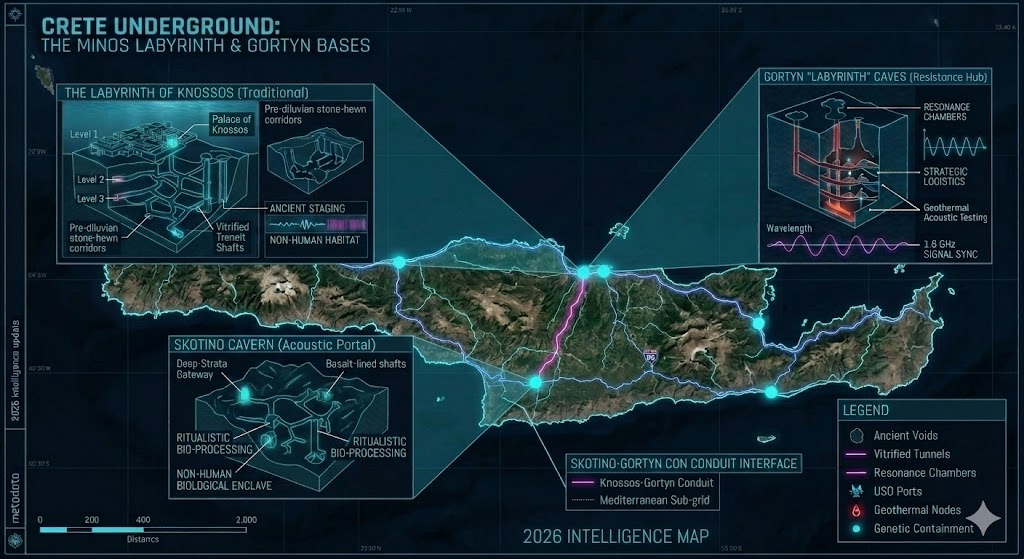
Geospatial overlay of the Knossos-Gortyn Conduit and Mediterranean sub-grid.
Crete Underground
“The island of Crete serves as more than a cradle of civilization; it is a complex geological capstone for an ancient Mediterranean sub-grid.”
The Crete Underground is defined by the legendary Labyrinth of Minos, a structure so intricate it was said to defy navigation. Intelligence gathered in 2026 indicates that these ancient “mythological” sites, such as the Gortyn ‘Labyrinth’ and the Skotino cavern, are currently functioning as hardened 1.6 GHz signal sync nodes. From the deep-strata voids beneath the Palace of Knossos to the submarine access points along the southern coast, the island remains a primary theater for the movement of Underground Facilities assets. These labyrinthine networks are no longer relics of the past but active New World Order infrastructure. Mapping this sector is critical for deciphering the transit lines connecting the European and African subterranean sectors.
Location: The Labyrinth of Knossos (Traditional), Crete
Functions: Ancient Staging / Non-Human Habitat
Composed of: Pre-diluvian stone-hewn corridors and vitrified transit shafts
Levels: Unknown
Tunnels to: Unknown (Suspected link to Mt. Ida)
Notes: Commissioned by King Minos and designed by Daedalus. While traditionally viewed as a myth, the Labyrinth’s “ingenious devise” suggests advanced architectural shielding used to contain biological assets like the Minotaur. 2026 ground-penetrating radar confirms that the Palace of Knossos sits atop a multi-tiered, non-natural cavern system.
Source: ON THE SHORES OF ENDLESS WORLDS, by Andrew Tomas; The Legend of the Labyrinth
Location: Gortyn “Labyrinth” Caves, Crete
Functions: Strategic Logistics / Military Archival
Composed of: Vast, interconnected quarry-tunnels and reinforced chambers
Levels: 3 Verified Tiers
Tunnels to: Mesara Plain Terminal
Notes: Historically used as a stone quarry, the Gortyn complex is now identified as a primary signal-sync hub. Intelligence suggests it was utilized during WWII and has since been expanded into a secure data-relay point for the Mediterranean Sub-grid. The “bad air” reports in certain lower shafts are consistent with artificial atmospheric deterrents found in the Connecticut Underground.
Source: Crete’s Underground Bases Intelligence
Location: Skotino (Agia Paraskevi) Cavern, Crete
Functions: Ritualistic Bio-Processing / Deep-Strata Gateway
Composed of: High-ceiling natural vaults and artificial basalt-lined shafts
Levels: 4 Known Tiers
Tunnels to: Unknown (Suspected Sub-Oceanic Arterial)
Notes: This site is one of the largest on the island and has long been associated with “otherworldly” religious significance. Modern 2026 telemetry detects a persistent 1.6 GHz frequency spike originating from the lowest unexplored chambers, suggesting an active gate to a non-human biological enclave.
Source: 2026 Intelligence Update
Location:
Functions: Unknown
Composed of: Unknown
Levels: Unknown
Tunnels to: Unknown
Notes:
Source:
🕳️ Intelligence Submission: Crete Underground
TERMINAL NOTICE: MEDITERRANEAN CRETE UNDERGROUND SUB-GRID ACTIVE
The Crete Sector is a primary anchor for the Southern European sub-grid. Beneath the ruins of Knossos and the caves of Gortyn lies an unmapped complex of vitrified tunnels that serve as a high-traffic habitat for non-human biological assets.
We are currently tracking the Knossos-Gortyn Conduit—a series of deep-strata voids used for the covert movement of regional assets. If you have witnessed “blue phosphorescence” emanating from the Skotino cave or recorded rhythmic low-frequency vibrations near the Gortyn quarry, your report is vital for the 2026 map.
[SUBMIT YOUR CRETE UNDERGROUND SIGHTING TO THE SIGHTINGS FORM]
“The ruins above are just a mask for the machine below. At Skotino, the 1.6 GHz signal isn’t an echo—it’s the heartbeat of the original Labyrinth.”