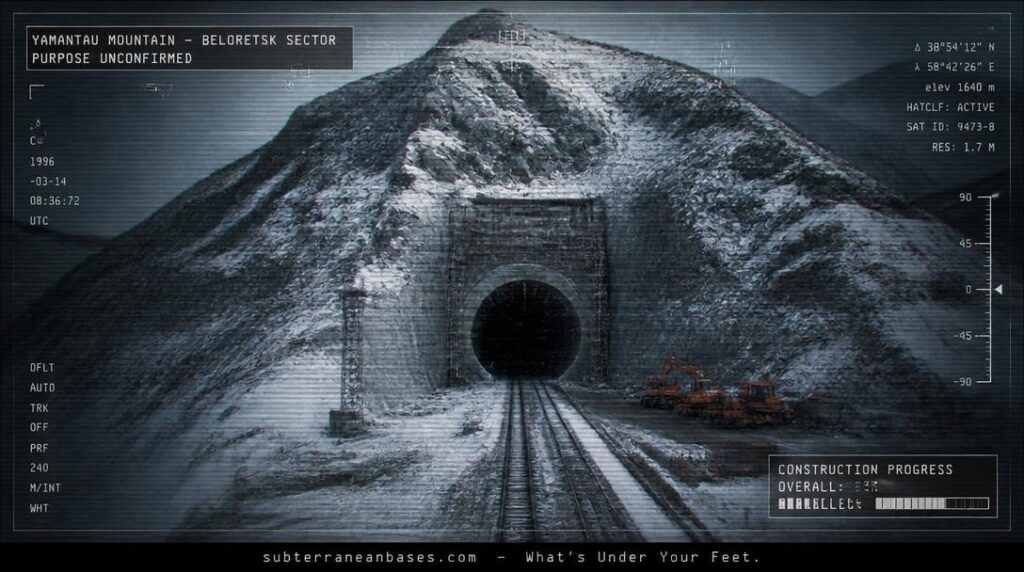
Russia's Yamantau Mountain complex — served by railroad and highway, built by thousands of workers, at a time when Russia said it couldn't afford nuclear disarmament.
On April 16, 1996, the New York Times reported something that should have made front pages for weeks: Russia was building a mammoth underground military complex inside Yamantau Mountain in the southern Urals — served by a railroad, a highway, and thousands of workers — at the same time that the Russian parliament was complaining it couldn’t pay $250 million in back wages and was asking the United States for money to dismantle its nuclear weapons. When asked what the facility was for, Russian officials gave four different answers: a mining site, a treasury repository, a food storage area, and a nuclear war bunker. American intelligence, spending nearly $30 billion a year, couldn’t answer the question either.
Patricia Neill’s ParaScope analysis draws the obvious parallel: Yamantau is Russia’s Mount Weather — and it’s being built with a financial shell game that may involve American taxpayer dollars sent to Russia for nuclear disarmament. U.S. law requires the Administration to certify that funds sent to Russia are used for weapons dismantlement. But if the Russian government can’t afford back wages while simultaneously pouring resources into a mountain-sized underground complex, the certification is either a lie or a formality. As one Pentagon official put it: “We can’t say with confidence what the purpose is, and the Russians are not very interested in having us go in there.”
Mount Weather’s Russian Twin
By Patricia Neill
Matrix Editor
On April 16, 1996, the New York Times reported on a mysterious military base being constructed in Russia: “In a secret project reminiscent of the chilliest days of the Cold War, Russia is building a mammoth underground military complex in the Ural Mountains, Western officials and Russian witnesses say. Hidden inside Yamantau mountain in the Beloretsk area of the southern Urals, the project involved the creation of a huge complex, served by a railroad, a highway, and thousands of workers.” The New York Times article quotes Russian officials describing the underground compound variously as a mining site, a repository for Russian treasures, a food storage area, and a bunker for Russia’s leaders in case of nuclear war. It would seem that the Russian Parliament knows as little about Russian underground bases as the Congress knows about Mount Weather in the United States.
“The (Russian) Defense Ministry declined to say whether Parliament has been informed about the details of the project, like its purpose and cost, saying only that it receives necessary military information,” according to the New York Times. “We can’t say with confidence what the purpose is, and the Russians are not very interested in having us go in there,” a senior American official said in Washington. “It is being built on a huge scale and involves a major investment of resources. The investments are being made at a time when the Russians are complaining they do not have the resources to do things pertaining to arms control.” Where’s the Money Coming From? The construction of the vast underground complex in Russia may very well become a cause of concern to the Clinton Administration.
The issue of ultimate purpose for the complex, whether defensive (as with Mount Weather) or offensive (such as an underground weapons factory) is not the only issue Mr. Clinton has to worry about. The real cause for concern is that the US is currently sending hundreds of millions of dollars to Russia, supposedly to help that country dismantle old nuclear weapons. Meanwhile, the Russian parliament has been complaining to Yeltsin that it cannot pay $250 million in back wages owed to its workers at the same time that it is spending money to comply with new strategic arms reduction treaties. Aviation Week and Space Technology reported that “It seems the nearly $30 billion a year spent on intelligence hasn’t answered the question of what the Russians are up to at Yamantau Mountain in the Urals.
The huge underground complex being built there has been the object of U.S. interest since 1992. ‘We don’t know exactly what it is,’ says Ashton Carter, the Pentagon’s international security mogul. The facility is not operational, and the Russians have offered ‘nonspecific reassurances’ that it poses no threat to the U.S.” U.S. law states that the Administration must certify to Congress that any money sent to Russia is used to disarm its nuclear weapons.
However, is that the case? If the Russian parliament is complaining of a shortage of funds for nuclear disarmament, then how can Russia afford to build the Yamantau complex? Are the Russians building an underground city akin to Mount Weather with American taxpayer’s money? Could American funds be subsidizing a Russian weapons factory? Hopefully Congress will get a firm answer to these questions before authorizing further funding to Russian military projects.
(c) Copyright 1996 ParaScope, Inc.
Executive Summary:
Yamantau Mountain — Russia’s Underground Military Complex and the American Money That May Be Paying for It
Patricia Neill’s 1996 ParaScope analysis examines the New York Times report on Russia’s construction of a massive underground military complex inside Yamantau Mountain in the southern Urals — a project involving thousands of workers, railroad and highway infrastructure, and an undisclosed budget, all while Russia claimed insufficient funds for nuclear disarmament compliance. The article draws a direct comparison to Mount Weather, the U.S. Continuity of Government facility in Virginia, and raises the question of whether American aid dollars designated for Russian nuclear dismantlement are being diverted to underground base construction.
The piece highlights the intelligence gap: $30 billion in annual U.S. intelligence spending has not answered the basic question of what Yamantau Mountain is for. As Aviation Week and Space Technology reported: “The facility is not operational, and the Russians have offered ‘nonspecific reassurances’ that it poses no threat to the U.S.”
About the Author