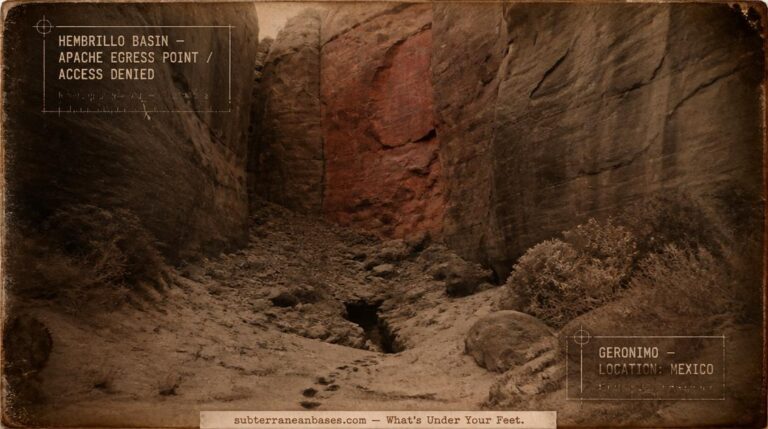
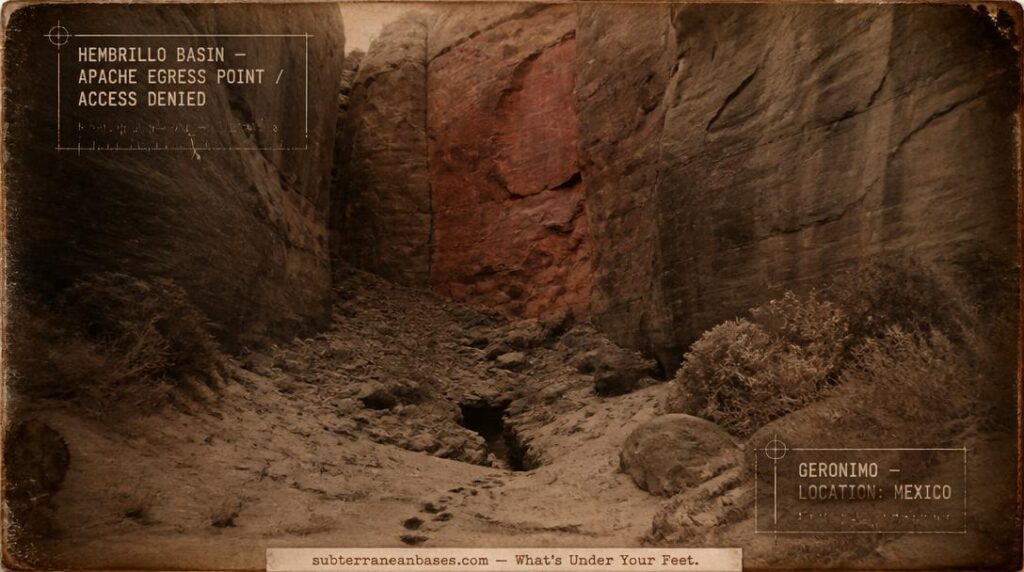
The Cavalry chased Geronimo into box canyons and he vanished — appearing hundreds of miles away in Mexico a day later. The tunnels beneath the American Southwest may explain how.
At the turn of the twentieth century, the United States Cavalry chased Geronimo and his braves into box canyons across Arizona — and the Apache vanished. Not retreated, not escaped around a ridge. Vanished. A day or two later, Geronimo would be reported in Mexico, hundreds of miles distant. This happened not once but several times. David Hatcher Childress, in “Lost Cities of North America,” connects these disappearances to a system of ancient tunnels beneath the American Southwest — the same system that Navajo informants have confirmed to researchers, and that the Caribe Indians described to Christopher Columbus when he landed on Martinique: Amazon warriors who fled persistent suitors by retreating into underground passages and meeting them with a hail of arrows.
Childress’s research links the Apache heartland — the Hembrillo Basin of southern New Mexico, including Victorio Peak, Hard Scrabble Peak, and Geronimo Peak — to a network of honeycombed tunnels, underground rivers, and booby-trapped staircases that the Apache guarded with uncharacteristic ferocity. Chief Victorio held off the Cavalry at Hembrillo Spring for two days, fighting for what appeared to be a desert water source but was in fact the entrance to a subterranean headquarters. A mural at Hembrillo Spring, believed to contain a map to the underground complex, was destroyed with six sticks of dynamite in 1973 — allegedly by White Sands military officers. As Childress concludes: the vast military reserves of Utah, New Mexico, and Arizona sit upon these underground worlds, and it is not hard to deduce that restricting public access — and conducting underground nuclear testing in the 1970s — may have been the point all along.
Apache Underground!
Below, the reader will find two short excerpts from the book Lost Cities of North America, by David Hatcher Childress. At the very bottom there is a very interesting conclusion or two.
Page 308, Excerpt: Stories of tunnels abound in Peru and other areas of South America. Many researchers believe that these tunnels run for hundreds of miles through the mountains, as far south as Chile, as far north as Ecuador or Columbia, as far to the east as the Amazon jungles. As for North America. some historians believe that a similar set of tunnels exists in Arizona and New Mexico, if not Utah, Nevada and California. At the turn of the last century, while the American army was pursuing Geronimo around Arizona, he and his braves would ride into box canyons with the Cavalry in hot pursuit. The Indians would literally vanish. leaving the U.S. Army totally mystified. A day or two later, it would be reported that Geronimo and his troops had suddenly turn up in Mexico, hundreds of miles distant.
This had happened not once, but several times. Is it possible that Geronimo was using a system of ancient tunnels that exist in the American southwest? Navajo Indians in New Mexico and Arizona have told me the same story—that certain members of their. tribes know about these tunnels, but keep them secret. Similarly, Christopher Columbus wrote that when he landed on the Caribbean Island of Martinique, a story of tunnels was brought to his attention. The Caribe Indians told the Spaniards about the Amazon women who lived without men. Columbus and his crew were informed that these women warriors would hide in ancient subterranean tunnels if they were bothered by men. If their persistent suitors followed them Into the tunnels, the Amazons cooled their passions with a flurry of arrows from their strong bows
Other tunnels are said to exist in India, Tibet and other parts of Central Asia, in the Ahaggar Mountains of Algeria, and even in Europe and Britain.
Page 313, Excerpt: Emerald mines, turquoise mines and a river of gold are a strong motivation to traders, and it is important to remember that the Gila River Basin was a huge, sophisticated metropolis of artificial canals and gardens. A sophisticated buying public was near to the mines. The emerald mines were apparently in the vicinity of Sante Fe, according to Northrop, but the location of these ancient mines remains a mystery.
The ancient mines and massive gold cache at Victorio Peak and Hard Scrabble Peak, both in the Hembrillo Basin area, were constantly guarded by Apache war parties. At one point, the Apache chief Victorio held off the American Cavalry at the Hembrillo Basin spring for two days. It was unlike the Apache to stand and fight, since they used guerrilla tactics so well. The American Cavalry, out of water, was fighting to get to the spring. Eventually they made it, but it was curious to them why the Apache had fought so hard over a spring in the desert.
The answer is that this spring, and the mountains in the immediate vicinity, was their secret. headquarters. And what a headquarters it was! Victorio Peak and Hard Scrabble Peak, as well as possibly Geronimo Peak, were all honeycombed with tunnels, caves and secret entrances. The Hard Scrabble Peak entrance led down a flight of hundreds of steps to an underground river.
The last step was booby trapped with a deadly arrow device. It is all like out of some 40s cliffhanger serial. Just as incredibly, there was once a mural painted on a rock at Hembrillo Spring. This fascinating mural was blown up with six sticks of dynamite in 1973, probably because it was believed that the mural contained a map to the gold mine. Chandler alleges that the White Sands Military officers had something to do with it, since the entire area of all of these peaks, and their underground tunnels, lies on a special Military Reserve, the same reserve where the first Atomic Weapon was detonated at Alamogordo in July of 1945.
End of Lost Cities of North America quote. What we can surmise from this information is that the very broad military reserves of Utah, New Mexico and Arizona sit upon a vast system of underground tunnels and cavern worlds, the same as in the case of the underground worlds that have been presented in the other pages of this site. These worlds are as vast as entire geographical regions. It is not hard to conclude that a purpose of these military reservations is to prohibit entry to the general population. It is also not hard to conclude that the underground nuclear testing which took place in the 1970s had the purpose of imploding and destroying some of those worlds from above. These would be the underworlds of the Apache.
Executive Summary:
The Tunnels Geronimo Knew — Ancient Underground Networks, Apache Guerrilla Warfare, and the Military Reserves That Sit on Top of Them
David Hatcher Childress’s excerpts from “Lost Cities of North America” document the repeated disappearance of Geronimo and his forces into box canyons during the Apache Wars, emerging hundreds of miles away in Mexico — incidents attributed to an ancient tunnel system beneath the American Southwest. Navajo informants have confirmed knowledge of these tunnels, which Childress connects to the honeycombed underground complexes of Victorio Peak, Hard Scrabble Peak, and Geronimo Peak in the Hembrillo Basin, including stairways to underground rivers, booby-trapped passages, and a mural destroyed by dynamite in 1973.
Childress concludes that the military reservations spanning Utah, New Mexico, and Arizona serve a dual purpose: prohibiting civilian access to the tunnel entrances, and — through underground nuclear testing — potentially destroying the subterranean worlds themselves.
As the text notes:
“These worlds are as vast as entire geographical regions. It is not hard to conclude that a purpose of these military reservations is to prohibit entry to the general population.”
About the Author