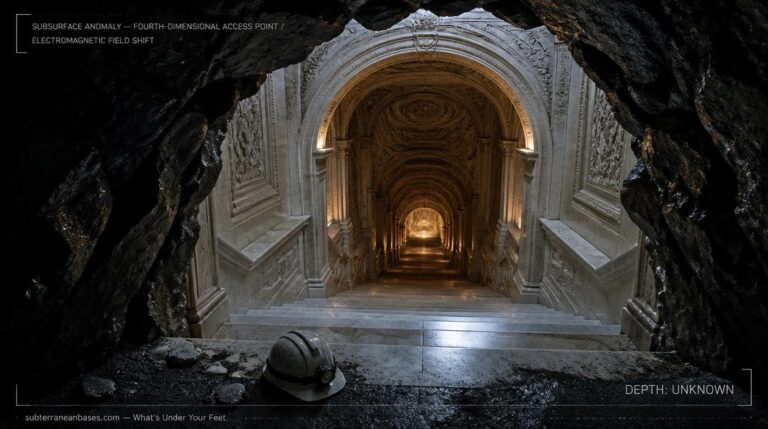
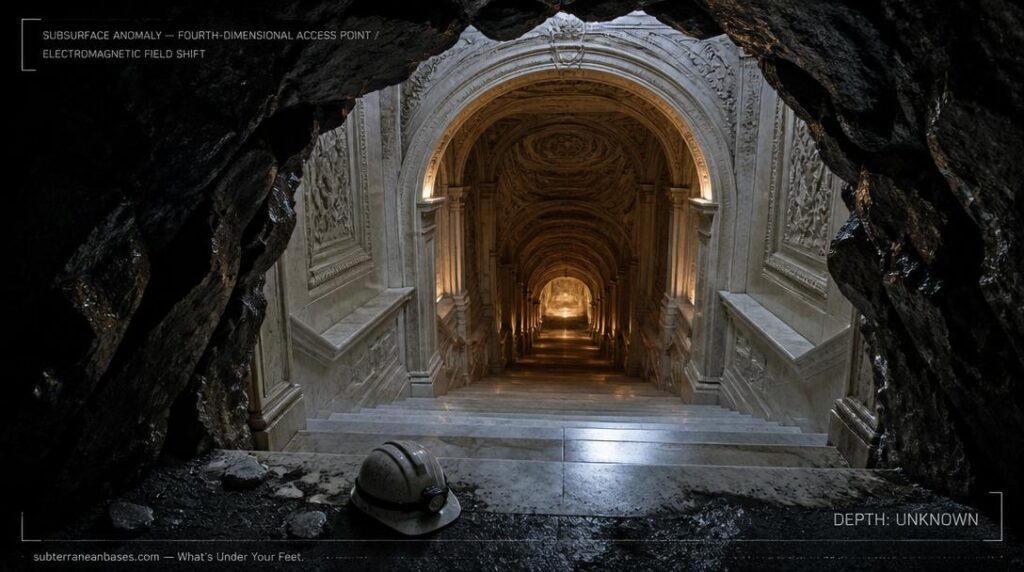
In 1963, two Pennsylvania coal miners found a massive door in a tunnel, behind which they discovered a marble stairway descending into the unknown — and the sound of machines below.
In 1946, a writer named Richard Shaver published a story in Amazing Stories Magazine that should have been dismissed as science fiction — except that hundreds of readers wrote in to say they had experienced the same thing. Shaver claimed he had spent weeks living underground with demon-like beings whose descriptions matched the ancient legends of nearly every culture on Earth: an inconceivably talented race that settled inside the planet long before humans appeared on it and wants nothing to do with us. The readers didn’t just corroborate the concept — they described underground cities, conversations with residents, and technical inventions that guaranteed comfortable existence in the planetary interior. The “Shaver Mystery” became one of the most controversial events in mid-century paranormal publishing and gave direct impetus to the study of subterranean civilizations.
This article traces the underground civilization hypothesis from Shaver through Edmund Halley’s hollow Earth address to the Royal Society, Jules Verne and Edgar Allan Poe’s literary treatments, the failed American expeditions of the 18th and 19th centuries, the Third Reich’s 1942 top-secret underground expedition, the 1963 discovery by Pennsylvania coal miners of a marble stairway behind a massive door, and the ESSA satellite photographs of the late 1970s showing a regularly shaped dark spot at the North Pole. Anthropologist James McKenna’s Idaho cave expedition — where screams, moans, and human skeletons preceded an unbearable brimstone stench — provides the visceral detail. The article’s most interesting proposal: underground cities may exist in a fourth-dimensional space accessible only when Earth’s electromagnetic field shifts, temporarily opening tunnel entrances that are otherwise invisible — and that structures like Stonehenge were built to mark these gateways.
Aliens live on Earth, under the ground
A lot of respectable scientists and writers believed that Earth is hollow inside
Rumors about underground towns appeared for the first time in 1946.
The person to launch the rumors was Richard Shaver – writer, journalist and scientist. His incredible story about contacts with aliens living under the ground was published in Amazing Stories Magazine. Shaver said that he had spent several weeks living under the ground with demon-looking aliens, whose descriptions can be found in ancient legends and fairytales. Almost every nation has a tale of an ancient race, who settled in planet Earth long before humans appeared on it. Those underground creatures are described as inconceivably talented, brilliant and culturally educated – they do not want to have anything in common with humans.
One could refer to the story from the American writer as a fruit of his vivid imagination. However, hundreds of readers responded to the publication. They wrote that they had visited underground cities, talked to their residents and saw unimaginable technical inventions, which guaranteed a comfortable existence in the very depth of the planet. Furthermore, the technologies of underground aliens give them an opportunity to control the minds of humans. The unbelievable story exerted an immense influence on scientists and gave an incentive to the study of paranormal activities. English astronomer of the 17th century, Edmund Halley, writers Jules Verne, Edgar Allan Poe and some others wrote in their works that planet Earth is a hollow sphere. American authorities were preparing a special scientific mission in 18-19 centuries to explore the Earth’s hollow depth. The scientists of the Third Reich were very interested in the mysterious underground world too.
A special top secret expedition was organized in 1942. German scientists also hoped to install new radar systems under the ground and draw closer to global reign. Unfortunately, the outcome of the intrigue is not known, but the hypothesis of the underground civilization developed further on during the second half of the 20th century. In 1963, two American coal miners, David Fellin and Henry Throne, found a large door in a tunnel, behind which they discovered a marble stairway. In England, miners can hear the sounds of mechanical devices under the ground, as they dig a tunnel. An English miner said that they had also found a stairway to an underground well. The sound of machines became more distinct, and the workers fled in fear.
When they returned to the tunnel, there were no stairs and no entrance to the well. An American satellite took very interesting photographs at the end of the 1970s. The photographs were published in many Western scientific magazines: the pictures depicted a dark, regularly shaped spot on the North Pole. The photographs were not defective: similar pictures depicting the same dark spot on the pole were taken several years later. Anthropologist James McKenna explored an ill-famed cave in the State of Idaho. McKenna and other members of the expedition could hear screams and moans, as they were moving hundreds meters deep into the cave.
The researchers found human skeletons soon, but they had to stop their quest: the smell of brimstone was unbearable. Geologists do not share the theory of the Earth’s huge cavity, although they do not exclude a possibility of numerous large hollow spaces in planet’s depths. Human life is hardly possible in those cavities: the temperature is too high and there is very little oxygen there. Some researchers believe that the underground civilization might be of an extraterrestrial origin. Aliens were probably tired of people’s eternal wars and atrocities, and moved under the ground, from where they comfortably observed the development of the mankind. What if UFOs appear in the sky from under the ground, not from other galaxies? However, if planet Earth is hollow inside, someone should have found the gateway to the underground world long ago. A group of American scientists believes that underground cities exist on Earth in the fourth dimension.
When the Earth’s electromagnetic field changes from time to time, entrances to the tunnels open, and accidental “visitors” may see the underground cities and their inhabitants. One of the theories says that many mysterious constructions, like the English Stonehenge for example, were built to designate entrances to underground cities. If there is a reasonable race living under the ground, it would be an explanation to a lot of inexplicable phenomena.
Executive Summary:
The Shaver Mystery and Beyond — From 1946 Reader Testimonials to Fourth-Dimensional Underground Cities
This article traces the underground alien civilization hypothesis from Richard Shaver’s 1946 Amazing Stories publication — which generated hundreds of reader testimonials corroborating underground city encounters — through Edmund Halley’s hollow Earth theory, the Third Reich’s 1942 underground expedition, the 1963 Pennsylvania coal mine discovery of a marble stairway, the ESSA satellite polar photographs, and James McKenna’s Idaho cave expedition where human skeletons and brimstone were found beneath audible screams and mechanical sounds.
The article proposes that underground cities may occupy a fourth-dimensional space accessible through electromagnetic field fluctuations — with ancient structures like Stonehenge marking gateway locations.
As the article frames the hypothesis:
“If there is a reasonable race living under the ground, it would be an explanation to a lot of inexplicable phenomena.”
About the Author